


A Family Affair: Max Faulker, Brian Barnes, and Their Connection to Royal Portrush

Updated: Jul 27, 2025
Passing down a legacy in golf involves more than just a sharing of clubs. It encompasses values, tradition, and a shared experience through sport. It fosters lessons in sportsmanship, promotes perseverance, and instills a love of nature, creating a vivid collection of memories that will last for generations. In some families, golf is like a birthright, handed down through generations, but for 25 year-old Hilary Faulkner, golf was viewed as "a most maddening game."
Hilary was the granddaughter of Gus Faulkner, an old-school golf pro who got his start in the game in 1910 at Walton Heath Golf Club in Surrey, England. It was there, at the age of 17, that golf was woven into Faulkner's DNA as he caddied for the great James Braid and learned the art of club-making, carving heads out of blocks of persimmon and sanding hickory shafts to get just the right taper. Gus served as head pro at Pennard Golf Club on the southern peninsula of Wales from 1919 until 1926, when he moved on to Bramley Golf Club, the place he would stay for the next 19 years.
Gus was passable as a competitive golfer. He won the 1922 Welsh Open while at Pennard, as well as the Western Mail Professional Tournament in '22 and '23 after finishing runner-up in '21. His best finish at The Open Championship was a T12 at Carnoustie in 1931, the same year he was nominated, but passed over, for a spot on the British Ryder Cup team. Although he enjoyed competition, Gus gained more recognition for his teaching, and one of his standout pupils was his eldest son, Max.
Max Faulkner was born on July 29, 1916, while his father was working at Bexhill-on-Sea. He picked up his first club at the age of 4, and learned the game under Gus's watchful eye on the links at Pennard. A naturally athletic child, Max enjoyed boxing almost as much as he did swinging a golf club. In fact, he was being educated for a career in business until, at the age of 12, he won the under-15 golf tournament at Pennard by a whopping 16 strokes. It was then that Gus bestowed upon Max a blessing that would affect the rest of his life. "This is the game for you," Max told him. "You have what it takes to win the Open one day." Within a year, he was playing scratch golf.
Max continued to compete, often overshadowed by his well-known father, but he soon began to blaze a trail for himself, making headlines with sub-70 rounds and winning matches throughout England. When Max was 16, he broke his father's course record at Bramley by a stroke. At the age of 17, he played in his first Open Championship at Royal St. George's in 1934 but missed the cut with a two-day total of 156. He qualified for the Open three of the next five years, and even led after the first round at St. Andrews in 1939, before coming back to the pack and finishing in a tie for 23rd.
After working for his father at Bramley, Max took a job as assistant pro at Sonning, and in 1938, was selected from a pool of 110 applicants to become head pro at Leamington Golf Club in Warwickeshire. He had been there only sixteen months before he enlisted in the Royal Air Force when Britain declared war on Germany. During the war, he served as a physical training instructor and was stationed in Liverpool, but despite his proximity to Hoylake and Royal Birkdale, he managed to play fewer than ten rounds of golf between 1939 and 1945.
After the war, Max began training with his father again. He won the Dunlop-Southport tournament in 1946 and the West of England Championship the following year, and after a stint at Worlebury, he took a job as an assistant under Henry Cotton at Royal Mid-Surrey. That was when things started to take off. In 1949, Faulkner won three tournaments—the Dunlop, the Penfold, and the Lotus—and held the third round lead at the '49 Open at Royal St. George's before fading to sixth in the final round. The following year at Troon, he finished fifth.
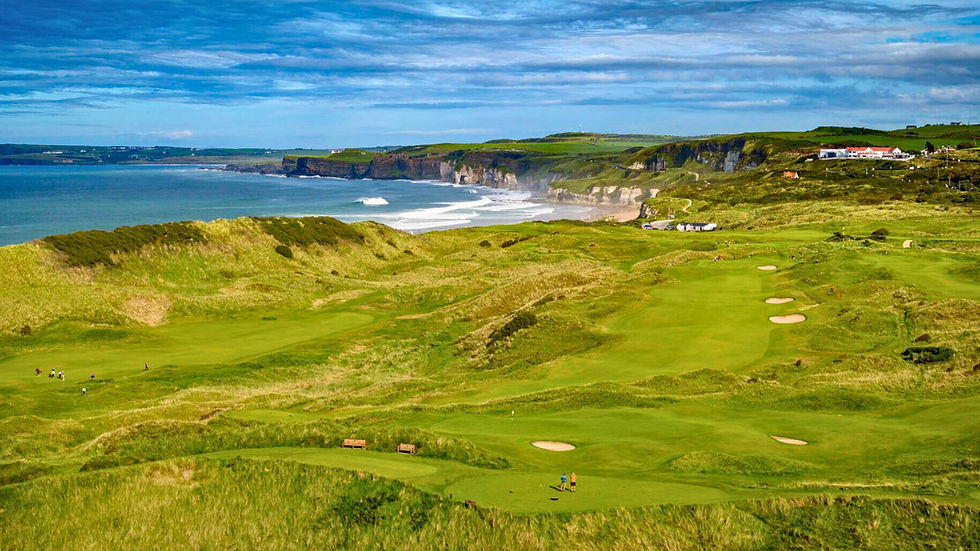
The 1951 Open marked the first time the Open Championship ventured off the island of Great Britain. It was held July 4-6 on the Dunluce Links at Royal Portrush in County Antrim, Northern Ireland, a spectacular venue on the edge of the Atlantic with all but three holes giving a view of the ocean. In the tradition of English and Irish courses, the holes of the 6,802 yard, par 72 layout bore names that often forewarned of their terror. Names like Giant's Grave, The Himalayas, Purgatory, and Calamity Creek. Whether from the gorse, the bracken, the unpredictable ocean breezes, or the sand dunes fiendishly placed there by Mother Nature, the Dunluce links were sure to present a challenge, but Max Faulkner awaited it with great anticipation.
With two consecutive top-tens already under his belt that season, Faulkner entered the 1951 Open like a man on a mission. He opened with a 1-under-par 71, that put him in a tie for third place with Bobby Locke, three strokes behind Jimmy Adams and Australian Norm von Nida. Following a 2-under par 70 in the second round, Faulkner carried a two-stroke lead over Norman Sutton into the final 36 holes. After two trips around Royal Portrush, they were the only two players under par.
Playing the third round under the spell of what he later called a "mystery guiding light," Faulkner finished the first 15 holes in 2-under par and led by four strokes when he arrived at the 16th (at the time, a 440 yard par-4 known as The Stables). Things seemed to take a turn when Faulkner hooked his drive so far left that it sat just inches from the post of a barbed-wire fence marking the boundary of the hole. From all appearances, it seemed his only option was a wedge shot back to the fairway, but instead of the safer play, Faulkner decided to tempt fate. He pulled out his 4-wood and with an abnormally steep back-swing, hit what his playing partner, American amateur Frank Stranahan, called “the greatest shot I’ve ever seen.” Faulkner started his shot out-of-bounds, then watched as it slowly began an arcing fade, re-crossed the boundary, landed in the fairway and bounded onto the green. He ended his round with three consecutive fours to take a six shot lead over Sutton and Argentinian pro Antonio Cerda heading into the final round that afternoon.
More than any other shot, the 4-wood at 16 epitomized Faulkner's mindset that week. He was convinced the '51 Open was his destiny. "There was no way I was going to lose," he would later say. So confident was Faulkner that when approached for an autograph prior to starting his final round, he signed it, "Max Faulkner, 1951 Open Champion." He played a conservative round that afternoon, shooting a workman-like 74 that he hoped would be enough to hold onto the lead, but Cerda had other plans. With an early run and a clutch short game, Cerda was 4-under par after 15 holes and needed three straight pars to close out a 68 to tie Faulkner and force a playoff. Like Faulkner had in the third round, Cerda hooked his next tee shot nearly out-of-bounds. However, unlike Faulkner, he chose the safe play back to the fairway but left his pitch shot in the rough. It took Cerda four more strokes to finish the hole with a double-bogey, and after two routine pars, the Claret Jug belonged to Faulkner. He had fulfilled his father's prophecy all those years ago. Max Faulkner was now the Champion Golfer of the Year.

In a world where golfers were expected to plod solemnly through their rounds dressed in gray and brown tweed, Faulkner was an anomaly. With his charismatic charm, jaunty wit, and trademark rainbow-hued golf attire, he was the British equivalent of Jimmy Demaret. In his Who's Who of Golf, Peter Allis said that Faulkner was one of the most talented British golfers of the era, but also the most eccentric. His bag contained an odd assortment of clubs with varying shaft flexes and lengths, and he was always toying with a new theory or testing out a new style of putter.
Over the course of his career, Faulkner won 14 tournaments on the European circuit, but 1951 at Royal Portrush would be his only Open. "It was all I ever wanted," he told the London Daily Telegraph. "I won just about every other tournament--including the British Masters and Matchplay event--but the Open meant everything to me. In fact, it meant so much that one victory in '51 sapped my will." Between 1947 and 1957, he represented Britain in the Ryder Cup five times. His final appearance was in 1957, when the European team won at Lindrick, breaking a 24 year drought in the event. They would not win another until 1985.
In 1964, Faulkner took over as chief instructor of the "Butten Boy" project, a scheme devised by millionaire businessman Ernest Butten and the British PGA with the goal of developing a U.S. Open and British Open champion within a five year timeframe. Intent on challenging American dominance of the game, Butten invested £40,000 of his own money to create a residential golf school at Sundridge Park. He hand-picked four of Britain's most promising young professional golfers--each of whom received a weekly stipend and had all tournament expenses paid--and provided them a comprehensive support system, including access to an optician, chiropodist, dietitian, physiotherapist, and body-building expert. They took IQ tests, learned techniques to improve their concentration, and even had courses in public speaking.
Max's pupils included Tom Horton, Alan Ibberson, Mike Ingham, and a powerful 19 year-old from Burnham named Brian Barnes. Born in England to Scottish parents, Barnes learned the game at the age of nine from his father, Tom, who was a native of Turnberry. A golf professional himself, Tom Barnes encouraged his son to excel in team sports like hockey and football while continuing to develop his golfing skills. Brian won several local and regional tournaments while attending Millfield school, and turned pro just weeks after winning the British Youth Open Amateur Championship in August of 1964. In October, he signed a three-year contract to become one of the "Butten Boys," and it was around that time that he met Max Faulkner's daughter, Hilary.
Born in 1942, Hilary Faulkner was two years Barnes's senior. Since her father served in the RAF during the war, and was often on the road playing in tournaments, much of her pre-teen life had been spent on her grandparents' farm near Godalming, where she developed her love for the great outdoors. She left home at the age of 15 to pursue a career as a secretary, but soon parlayed her interest in visual and dance arts into a job as a fashion model.
Barnes first met Hilary when she chauffered fee father to the golf course in his Rolls Royce. Barnes had a girlfriend back home and didn't show much interest at first, but he soon became smitten with her farm-girl wholesomeness and model's good looks...not to mention her love of sports...and the two became an item. In the summer of 1965, when Max resigned his £3,000 per year teaching position over philosophical differences with Butten, Barnes remained loyal Max...and to Hilary. Barnes offered her lessons, she quickly accepted, and soon she was playing to an 18 handicap. In August of 1968, they announced their engagement, and on December 31 of that year, they were married. "Max and I are thrilled," said Max's wife, Joan, "Brian is such a nice boy, and, of course, this will keep golf in the family."

Between 1967 and 1970, Barnes won four tournaments in Britain, Australia, and South Africa. When thet European Tour was founded in 1972, he became one of the tour's leading players, winning nine events between 1972 and 1981, and finishing in the top ten in the Order of Merit every year from '72 to '80. Barnes made the cut in the Open Championship 16 successive years and had three top-tens, the best of which was a fifth place finish at Muirfield in 1972. He won just about every national championship on the European continent, but--like all of the other Butten Boys--the one that eluded him was The Open.
Barnes played in six consecutive Ryder Cups between 1969 and 1979, compiling a record of 10-14-1, which included a 5-5-0 record in singles. One of the highlights of his career came at the 1975 Ryder Cup, when he defeated Jack Nicklaus twice in one day, winning the morning match 4 & 2 and spoiling the Golden Bear's chance at redemption by a 2 & 1 margin in the afternoon. Hilary walked the course for both matches with Barbara Nicklaus and had fond memories of how gracious and sporting she was that day.
Barnes went into partial retirement in the mid-1980s and played an abbreviated schedule while helping Max Faulkner run a golf course in Sussex. When he became eligible for the Seniors Tour in 1995, Barnes entered his first Senior British Open, which was slated to be held that summer at Royal Portrush. This historic course had not hosted a major championship since the 1951 Open due to the ongoing troubles in Northern Ireland, but the peace of a temporary ceasefire allowed the tournament to proceed as planned.
Competing on the same course where his father-in-law had won the Open Championship 44 years earlier, Barnes performed exceptionally well. He ended regulation play at the top of the leaderboard, tied with American Bob Murphy, and on the third hole of a sudden-death playoff, holed a miraculous 50-foot putt for eagle at the par-5 17th to clinch the title. In at least one way, this championship was Barnes's destiny. "Since I realized two years ago that my first Senior Open was going to be played at Portrush, where Max won his championship, I have dreamed of this win," he said afterward. "It has been a long journey."

Barnes won the European Senior Tour's Order of Merit in 1995, then came back to Portrush the following year and won the Senior Open again, this time by a convincing three stroke margin over David Oakley and Bob Charles. He was the first player ever to successfully defend his title at the Senior Open. That same year, he played in the last of his 21 Open Championships, making the cut for a final time and finishing T60. He played four more years on what is now the PGA Tour Champions, notching one more win at the AT&T Canada Open and top-fives at both the U.S. and British Senior Opens in 1998, before rheumatoid arthritis put an end to his touring days in 2000.
From those first golf lessons in the 1960s to his final competitive putt at Royal County Down in 2000, Hilary had been there for it all. She had seen him through the good times and bad; the wins and the losses; through the birth of their two children; and the incessant travel required of a touring pro. She had seen him through his battles with alcohol, when he played tournaments drunk and famously--or infamously, as it were--marked his ball with a can of ale before holing his winning putt at the Scottish PGA Championship in 1981. She had also been there for his sobriety, when he came back to win two British Senior Opens. A reporter for the Daily Telegraph once claimed that Hilary had a "genuine ignorance" for the game, but in truth, she knew it all too well. How could she not? It was in her blood. Brian relied on Hilary's opinions as golfer relies on a good caddie. She understood the pressures of a top touring pro, after all she was married to one and was raised by another.

Reflecting back on his career, Max Faulkner once lamented, "But for the War, I honestly think I might have won the Open on three or four occasions." There were other British golfers who could say the same. But despite their successes and failures, there was an intimate connection between Royal Portrush and the story of the Faulkner-Barnes family, dating back to Max's third place finish there in the 1947 Irish Open. How does one explain that the winners of the only three major championships hosted there over a span of 45 years came from the same family? What was the "mystery guiding light" that led Faulkner to his 1951 win, and was it there for Barnes in '95 and '96? Were it not for the "Troubles," and Portrush's removal from the Open rota, might Barnes have captured at least one Open Championship? As Hilary was known to say whenever Brian brooded over what might have been, "So what if (he) had?"
It's like Scottie Scheffler said before the start of this year's Open at Royal Portrush, winning championships may not be all it's cracked up to be. "This is not a fulfilling life," he said. "It's fulfilling from a sense of accomplishment, but it's not fulfilling from a sense of the deepest places of your heart. There's a lot of people that make it to what they thought was going to fulfill them in life. And then you get there, then all of a sudden you get to No. 1 in the world, and they're, like, what's the point? I really do believe that because, you know, what is the point?...Why do I want to win the Open Championship so badly?"
Why, indeed? For some, it may be for the fame and recognition; for others, a desire to sit atop the pinnacle of their sport. For others still, it's etched into their genetic code, a divine destination that completes the circle of their lives. But the greatest thing about golf is that you don't have to win trophies to love the game. Your name doesn't have to be Morris, Park, Palmer, or Nicklaus...or even Faulkner or Barnes, for that matter. Whether driven by the allure of fame, the pursuit of excellence, or an intrinsic passion for the game, each golfer finds their own meaning in the sport, and it doesn't require being a champion to pass that love down to the next generation.
As this year's Open draws to a close, it is shaping up to be a good one. There will be memories made, and champions crowned, but the world will keep on spinning. Ultimately, what truly matters is that the love for golf transcends the need for accolades. It's a game that can be cherished and shared regardless of one's age--or even one's status as a champion--and it's this enduring appreciation that allows the spirit of the game to flourish, inspiring future generations to embrace this “maddening game” not just as a competition, but as a lifelong passion.


Comments