


The Birkdale Redemption: Ian Baker-Finch’s Beautiful Closure

Updated: Jul 24

When Ian Baker Finch won his first PGA tournament, the 1989 Southwestern Bell Colonial Invitational, Mark Wohlers was an on-again-off-again starter with the Atlanta Braves' Class A farm team in Sumter, South Carolina. Twenty-eight year-old Baker-Finch was a 10-year golf pro from Australia playing his first full year on the PGA Tour. Nine years his junior, Wohlers grew up in Holyoke, Massachusetts, where he pitched and played first base for the Holyoke High Purple Knights before being selected in the eight round by the Atlanta Braves in the 1988 MLB Draft. They were two different men, from two different backgrounds, each playing the sport they had loved since their childhood. Little did they know that over the next eight years, they would experience similar fates, rising to the pinnacle of their respective sports only to see their careers unravel like a dime store sweater.
Baker-Finch grew up in the Sunshine Coast region of Australia on a farm in the logging town of Peachester, Queensland. He was introduced to golf at the age of 9, when his father, Tony, and a group of civic leaders were given 100 acres of swampland upon which to build the area's first golf course. When Beerwah Golf Club was opened as a 9-hole course in 1970, Baker-Finch mostly caddied for his dad until he got his first half-set of clubs at age 12. He labored in the tobacco and pineapple fields, finally earning enough money to purchase his first full set by the time he turned 13.
While he enjoyed playing tennis, cricket, and soccer, golf was his chosen game, and he sometimes took some ribbing when he carried his clubs with him to school in order to practice afterwards. He practiced religiously, developing his game while attending clinics led by Australian pros like Charlie Adcock, Paul King, and Charlie Earp, but his "A-HA!" moment came when he discovered Jack Nicklaus's classic book, Golf My Way, which became his golfing bible. His love of the game and his dedication to practice paid off when he won the 13 year-old age group at the Queensland schoolboy championship and later, the Gary Player Classic.
At the end of his junior year of high school, Baker-Finch decided to leave school to become a golf pro. He moved two hours north to become an apprentice under Gary Wright at Gympie Golf Club, where he learned the profession, including how to care for a golf course and repair golf clubs. After three years as an assistant, he became a fully qualified pro in 1979. He managed the pro shop and provided lessons at the club, while also working part-time on the farm to earn enough money to travel and participate in tournaments. He played in mini-tour events, pro-ams, and tournaments on the Australasian tour, aspiring to win tournaments like Peter Senior, Greg Norman, and Wayne Grady, who joined the tour a few years before him.
His first professional victory at the 1983 New Zealand Open qualified him for the 1984 Open Championship at St. Andrews, and he certainly made the most of his opportunity, shocking everyone in the Auld Grey Toun that weekend when he held the lead after 36 and 54 holes. Paired with Tom Watson in the final group on Sunday, Baker-Finch slipped to 9th place after a disastrous 79, while Watson lost a back-nine duel when Seve Ballesteros birdied the 18th to win his second Open Championship.
Finchy first played on the PGA Tour in 1985, mostly as an invitee, and qualified for tour membership with a third place finish at the 1988 World Series of Golf. He began to play regularly in the U.S., earning a two-year exemption in 1989 with his win at Colonial, and finished 16th on the PGA Tour money list in 1990, courtesy of three runner-up and two third-place finishes. At that year's Open Championship, Baker-Finch found himself once again in the final group on Sunday, but he had to settle for a tie for sixth place, witnessing Sir Nick Faldo claim the title of Champion Golfer of the Year for the second time from a front-row seat.
In the weeks leading up to the 1991 Open at Royal Birkdale, oddsmakers gave Nick Faldo 6-1 odds to repeat as Open champion, followed by Ian Woosnam at 8-1, and the Great White Shark, Greg Norman, was listed at 20-1. Fellow-Aussies Wayne Grady and Steve Elkington were given 50-1 odds and Mike Harwood was at 66-1. Now the 25th ranked golfer in the OWGR, Baker-Finch was riding a streak of 20 consecutive cuts made and was playing some of the best golf of his career. Although he was a 50-1 long shot, the Sydney Sun-Herald said that his "aristocratic iron play and putting (was) tailor-made for Birkdale."
Blustery winds off the North Sea during the first two days of the Open kept scoring averages higher than usual, but even so, Seve Ballesteros managed an impressive 66 in the opening round to take the lead. It was a good tournament for Aussies with nine making the 36-hole cut, and chief among them was darkhorse Mike Harwood, who sat atop the leaderboard tied with Andy Oldcorn and Gary Hallberg at 2-under-par 138. Steve Elkington and Wayne Grady were one back, tied with a group of six players at 139, which included Ballesteros and American, Mark O'Meara. Two serviceable rounds of 71 had Baker-Finch four shots off the pace but still in the hunt at 2-over-par, along with Greg Norman, Ian Woosnam, Bernhard Langher, Graham Marsh, and Jodie Mudd.
Calmer winds on Saturday led to optimal scoring conditions, and Baker-Finch took full advantage, blistering Royal Birkdale with a course record 64 that included six birdies and an eagle. He finished the day tied for the 54-hole lead with O'Meara at 4-under-par, one shot ahead of Harwood and Eamonn Darcy and two ahead of Ballesteros. To many, Finchy's presence in the final group was a bit of a surprise, but it really shouldn't have been. A quick look at the PGA Tour's stats told the story. Baker-Finch was fifth in driving accuracy, second in putting, and third, behind Fred Couples and Steve Pate, in overall game. His 69.56 scoring average was second on tour, he was tenth on the money list having won $468,850, and delivered four top-10 finishes in his last 6 events, including a playoff loss to Bruce Fleisher at the previous week's New England Classic. When he led the Open back in 1984, he had been "a kid with stars in his eyes," but this time he was ready. He had learned a lot from his experience in '84 and again in '90. He was mentally tougher, he knew he could hole putts, and he had a very good feeling headed into Sunday's final round.
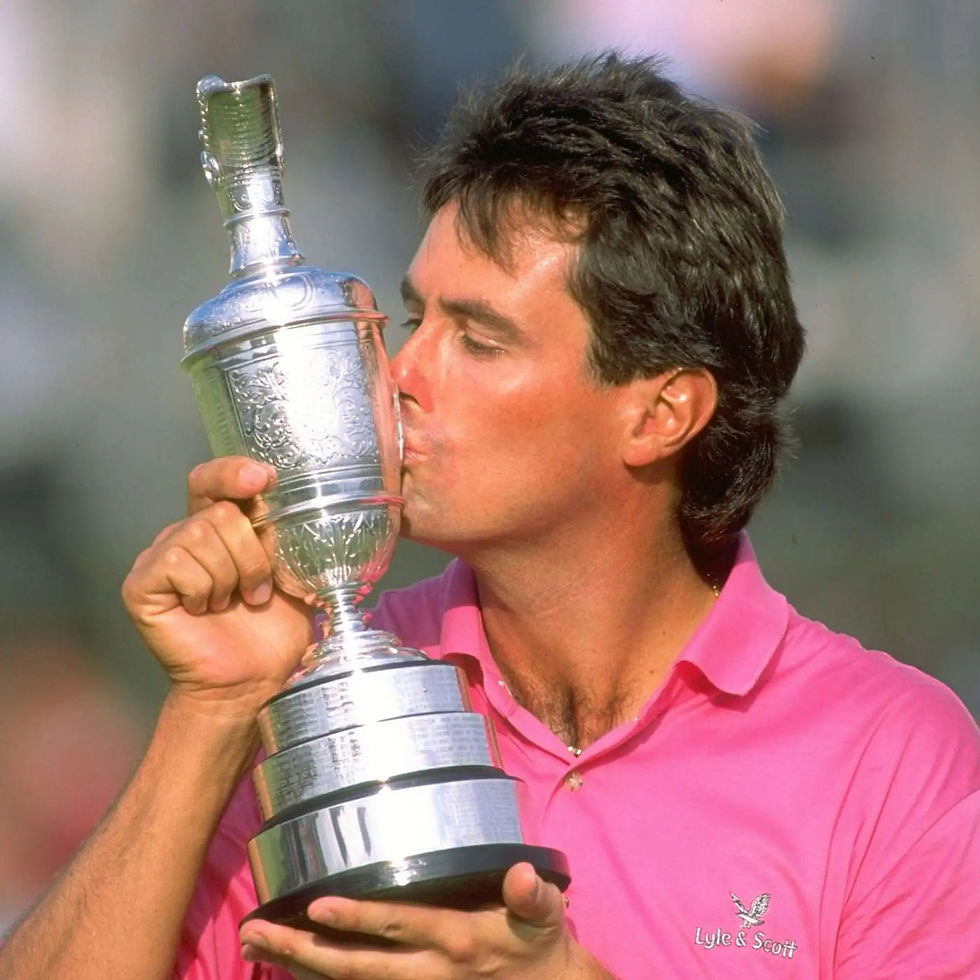
With conditions again ripe for scoring, Baker-Finch made it look almost effortless on Sunday, making birdies on five of the first seven holes as he went out in 29 on the front nine that afternoon. Holding a four stroke lead at the turn, he cruised to a final round 66, finishing at 8-under for the tournament, two strokes ahead of Harwood and three clear of O'Meara and Fred Couples. Playing with confidence and efficiency, he had learned from his past failures and didn't repeat them. Ballesteros had predicted he would crumble under the pressure, but he hadn't. "Experience is playing the way you know how," he said while holding the Claret Jug that evening. "That's what I did today. I knew what I had to do, and I did it. I proved myself a champion today."
Across the Atlantic, while Baker-Finch was putting the finishing touches on his Saturday 64, Mark Wohlers was recording his seventh save for the Triple-A Richmond Braves. Having struggled as a starter, the 21 year-old flamethrower had found his niche in the bullpen and was beginning to make a name for himself in the Braves organization. In 44 1/3 innings pitched, he had allowed only three earned runs, had struck out 57 batters, and his fastball often reached speeds of 98 miles per hour (one would eventually be clocked at 103). In July of 1991, Braves general manager John Schuerholz told reporters, "Everybody in baseball now knows the name Mark Wohlers."
To bolster the Braves' bullpen for their penant run, Wohlers was called up to the big leagues the very next month, and his impact was felt almost immediately, as he earned a save his first night on the Braves roster. He made five appearances in his first ten games, recording two saves to go along with his first win against the Montreal Expos, and on September 11, he pitched two innings of middle relief to combine with Kent Mercker and Alejandro Pena to no-hit the San Diego Padres. Three weeks later, the Braves clinched the NL West title, went on to defeat the Pittsburgh Pirates in the NLCS, and made their first World Series appearance since 1966, eventually losing to the Minnesota Twins.
Over the next several years, Wohlers's stock continued to rise as he pitched primarily middle relief while learning to control his fastball. After three years in the set-up role, he won the closer's job in 1995 and over the next three seasons, recorded 97 saves, including the Braves' 1-0 victory over the Cleveland Indians in the clinching game of the 1995 World Series. In the span of six years, Wohlers had risen from a shaky Single-A starter to establish himself as one of the best closers in Major League Baseball. He was also now a World Series Champion.
But as Wohlers's career was taking off, Baker-Finch's was headed in the opposite direction. His win at Birkdale earned him an exemption into The Open Championship and a five year exemption on tour. A couple of months later, he cracked the top 10 in the OWGR as the tenth best player in the world, and he closed out the season 13th on the money list with $899,228. When he won The Open, he said it was like being in Dreamland. "I know this will change my life in many ways I don't know," he told the press afterward, "but I'm not afraid of it. I'm a big boy now. I'm not starry-eyed now." Little did he know just how much things would change and how quickly.
He started the 1992 season well, with a win at the Vines Classic in Australia, a runner-up finish at the Tournament Players Championship, and a sixth place finish at the Masters, where he briefly held the clubhouse lead on Saturday after rain shortened the third round. Despite top-20 finishes at the U.S. and British Opens, and representing Australia in the Dunhill Cup, the remainder of his year was mediocre, and he slipped to 58th on the money list. In 1993, he fell to 144th. The hardest part for Baker-Finch was being unable to figure out what was wrong. He could shoot a 66 in a Wednesday pro-am, then go out and shoot a 76 in the tournament the very next day. It wasn't a matter of getting stronger or fitter. His problem was totally mental.
"You can't just say to yourself, 'Oh well, I'll walk in now,'" Baker-Finch reflected years later, "You've got to keep going and just try your hardest. That's all I could do." As touring pros increasingly embraced new technology with the rise of metal woods and forged or cavity-backed irons with square grooves, Finchy felt pressure to increase his distance off the tee. He tried changing his swing plane, but in hindsight he wished he had left it alone.
He sought help from two handfuls of the best coaches and psychologists. All were certain they could fix him, but nobody could. Things only got worse. One of those teachers, David Leadbetter, was frustrated over his inability to help. "Ian got to the point with me when he literally felt he was going to miss the ball," said Leadbetter, "particularly the driver. I mean, when you get the yips with the driver, what do you do? You can't go to the belly driver!" Leadbetter felt Baker-Finch's game was perfect for the majors. He wasn't ultra-long, but he had a stellar short game and was an excellent putter. Unfortunately, he was never content, and the desire for longer distance was his downfall. "He kept saying 'I've got to get longer...longer,'" Leadbetter recalled, "but he was long enough." With all of his other strengths, he should have been fine.
Instead of getting longer, his average driving distance fell from 259 yards in 1991 to 242 in 1996. Not only that, his driving accuracy (75.4% in 1991) fell to 38.9% and his scoring average ballooned to 75.47. He dreaded answering questions from journalists, who often followed him around the course just to see when his round was going to fall apart. When he finished tied for tenth at the Masters in 1994, it was the last time he made the cut in a major. It was also the last time he made a cut on the PGA Tour.
Sometimes he would hit a bad shot during practice and would begin to fear making the shot in competition. At the 1995 Open Championship at St. Andrews, he had a premonition prior to the tournament that he would duck hook his opening drive. Playing with Arnold Palmer on the opening day of the tournament, he did just that. He entered 18 events in 1995 and didn't make a plugged nickel. He was lost, searching. His confidence was shot. Not only was he playing poorly, he didn't even want to be out there. Ian Baker-Finch was suffering from the golfing equivalent of Steve Blass Disease.
Steve Blass was a right-handed starter for the Pittsburgh Pirates and was the hero of the 1971 World Series, pitching two complete game victories including the decisive seventh game. He won 19 games in 1972 and was runner-up for the National League Cy Young Award, but suddenly, and inexplicably, Blass lost his control the following year. He walked 84 batters in only 88 2/3 innings and his ERA sky-rocketed to 9.85. He was never able to regain his championship form and retired in 1975. It was the same fate that befell Mark Wohlers in 1998.
Wohlers had an All-Star performance in 1996, but after giving up a three-run home run versus the Yankees in Game 4 of the World Series in Atlanta, things just didn't seem the same. The following year, he recorded 33 saves, yet only one came after August 28, and the Braves lost the NLCS to the Florida Marlins. Off-field issues, criticism from the press, and a lingering chest wall injury took their toll in 1998. He altered his mechanics to avoid aggravating the injury, but his motion became erratic, and he struggled to find the strike zone. Despite working with physical therapists and pitching coaches while splitting time between Atlanta and Triple-A Richmond, he saw no improvement. In just 20 1/3 major league innings, he walked 33 batters, threw 7 wild pitches, and his ERA ballooned to 10.18. Finally, on August 21, 1998, the Braves placed him on the disabled list for the most humiliating reason of all: "the inability to pitch."

Ian Baker-Finch reached his rock bottom at Royal Troon during the 1997 Open Championship. Having taken six months off due to injuries after the previous year's Open, he debated even entering the tournament in '97, but as a past champion, he ultimately decided to compete. He soon regretted his decision. Battling fierce winds and his own personal demons, he shot a disastrous 92 that left him emotionally shattered. That was the turning point. The next day, he withdrew from the tournament, and four months later, little more than six years after hoisting the Claret Jug at Birkdale, Ian Baker Finch announced he was taking a leave from tournament golf.
Fortunately, Finchy's story does not end there. While rehabbing his injuries prior to the '97 Open, he had done television commentary for several events on the Australasian tour. Network officials from ABC saw his work and approached him about a job, and in July 1998, he was back at Royal Birkdale for The Open Championship, this time as a broadcaster. For the next eight years, he worked as a lead analyst for ESPN and a hole announcer for ABC. Then, in 2006, he was hired as lead analyst for CBS and held that position for the next 19 years. During that time, his highlights have included calling Adam Scott's Masters win in 2013, Jason Day's breakthrough win at the 2015 PGA Championship, Tiger Woods's historic comeback victory at the 2019 Masters, and Rory McIlroy completing the career Grand Slam in 2025.
When signing off of his final broadcast at the Wyndham Championship on August 3, 2025, his words reflected his love not only for the game of golf, but also for the people who love golf. “I really will miss calling those moments to the fans at home, because the fans are what we’re here for,” Baker-Finch said choking back tears. “We’re here for you, we’re here to entertain you, we’re here to bring you the pictures. We bring you live golf from all these beautiful venues around the country and around the world. This moment, I’ll just miss being in your homes every weekend.”

Baker-Finch now works as the Chair of the PGA of Australia with a goal of growing the sport both globally and locally, elevating the prestige of Australian professional golf, and recruiting top talent to play in Australian tournaments. His legacy in golf also lives on in other ways. In 2018, he returned his Champion Golfer's gold medal to the R&A to be displayed at Royal Birkdale alongside memorabilia from the other Opens the club has hosted. From the proceeds of that donation, he donated $50,000 to Challenge and Redkite, charities dedicated to helping children with cancer and their families, as well as Girls Golf Rocks, which serves to promote the game among Australian school girls. His unwavering commitment to advancing cancer research and nurturing the next generation of junior golfers continues today. He considers himself fortunate and blessed to have come from where he did to become a major champion and earn a special place in the game. "I respect it and honor it," he told FOX's Dane Heverin, "and treat it the way it should be.”
In 1998, Baker-Finch returned to Royal Birkdale a month before The Open, not only for the memories but also to reacquaint himself with the nuances of the course for his first job as an ABC analyst. On his first day back, he played a practice round in heavy wind and driving rain. Grandstands had already been set up for The Open, and the course was playing tough. Unbeknownst to him, the club's captain had obtained recordings of the crowd noise the day Baker-Finch made his triumphant walk to the 18th green in 1991, and as the group played the final hole, he played the tape full blast. Walking up the 18th fairway, Baker-Finch heard the noise. It was faint at first, but then grew louder, reaching a crescendo as he approached the green. Soon, he looked up to see Birkdale members, clubhouse attendants, and maintenance workers lining the windows and balconies of the clubhouse, cheering, clapping, and shouting encouragement.
Having endured those years of ineptitude, he had almost forgotten what it felt like to be applauded. His heart swelled inside his chest, his throat tightened up, and tears welled in his eyes as he was taken back to that glorious day in July 1991. For Baker-Finch, the show of respect was overwhelming, almost healing.
Like Baker-Finch, this year's Champion Golfer of the Year has known his share of disillusionment and medical adversity. When he drained his 11-foot birdie earlier today, Ryan Fox, who also got his start on the Australasian Tour, joined Michael Campbell and Sir Bob Charles to become only the third New Zealander to win a men's major golf championship. His life is sure to change in many ways, as Ian Baker-Finch can attest. It's hard to predict whether he will be a one-hit wonder or if he will go on to win other majors, but hopefully he can avoid putting too much pressure on himself. Baker-Finch would be the first to tell you, he put his faith in a number of highly regarded coaches, and in hindsight, he forgot about trusting the most important person: himself. "My life changed in that I felt like I had to play like that all the time," he told Heverin, "and I wish I realized that you don't play like that all the time."
As Fox embarks on this new chapter of opportunities and challenges, the lessons from Baker-Finch serve as a poignant reminder that the path to greatness is not solely paved with accolades but also with self-acceptance and resilience. In the world of golf, where the margins are razor-thin and the pressure can be overwhelming, finding balance will be crucial. Ultimately, the true measure of a champion may not just be the trophies collected, but the ability to navigate the highs and lows with grace. As Fox steps into the spotlight, the golfing community will watch with anticipation, hoping he embraces both the joys of victory and the wisdom of experience, forging a legacy that transcends the fairways. Only time will tell how his story unfolds, but one thing is certain: the journey has only just begun.
To read more about Ian Baker-Finch's incredible journey in golf, read Geoff Saunders's book,
Ian Baker-Finch: To Hell and Back, (Hardie Grant Books, 2025)


Very informative, this story reminds me what I experience each time I play golf. Don’t take for granted that good will only get better, embrace the moment and the opportunity to grow is the real reward. Great life lesson to learn.