


The Good Neighbor Policy: Jimmy Demaret Battles the PGA in Houston


When Memorial Park Golf Course in Houston hosted last week's LPGA Chevron Championship, it marked the first time in 75 years that professional golf tournaments have been held at Memorial Park and Mexico City's Club de Golf Chapultepec in consecutive weeks. Off-course news surrounding the events this year centered around Bryson DeChambeau's complaints about course conditions at Chapultepec, the lack of television coverage for the LPGA Chevron Championship, and the wading pool built adjacent to the 18th green at Memorial Park. In 1951, controversy erupted when foreign interests attempted to recruit PGA pros away from the Rio Grande Valley Open in Harlingen, Texas, creating a squabble between Jimmy Demaret and the PGA that involved fines, suspensions, sombreros, and even the U.S. State Department.
It all started when Demaret committed to playing in the Mexican Open, the Mexican Golf Association's national championship, in December 1950, even before the dates were set for the PGA's Rio Grande Valley Open. He notified the PGA Tournament Committee of his decision in December and again in January after the start of the 1951 season, and the committee expressed no objection. Weeks later, Raul Valdes, president of the Mexican Golf Association, and Mexican journalist Eduardo Salah met with PGA officials in Phoenix and again in Tucson to inform them of their intention to invite several more PGA pros to play in the tournament. PGA Secretary Horton Smith, Tournament Bureau chief Howard Capps, and two members of the tournament committee, Lawson Little and Chick Harbert, left under the impression that they wanted to add maybe a half-dozen lesser-known players to the field, but that's when the plot began to thicken.
While the PGA was in San Antonio for the Texas Open, Cary Middlecoff and Chick Harbert announced that they would be skipping the Rio Grande Valley Open in Harlingen the following week; Middlecoff to visit his ailing father in Memphis, and Harbert to tend to business matters in St. Petersburg, Florida. Along with Demaret, the defending Masters champion, players who had announced their intent to play in Mexico City included Dutch Harrison (who went on to win that weekend in San Antonio), 1941 PGA Champ Vic Ghezzi, Texan Morris Williams Jr., Ed "Porky" Oliver, Al Besselink, defending Mexican Open champion Tony Holguin, and 1940 US Open Champion Lawson Little. It was even rumored that Lew Worsham and Lloyd Mangrum might be playing in Mexico City. When that news broke, Rio Grande Valley Golf Association President Pete McNamee spoke with the press to announce that he was denying permission for Demaret, Mangrum, Worsham, and Williams to play in Mexico.
With Sam Snead sidelined because of a broken bone in his hand and Ben Hogan curtailing his schedule due to health reasons, it appeared that there would be few "name" players left in the field when the tour made its stop in Harlingen the following week. That's when PGA Secretary Horton Smith started a back-channel campaign to stem the flow of players heading south of the border. Always a stickler for the rules, Smith spoke to the other members of the Tournament Committee who were in San Antonio that week: Clayton Heafner, Dave Douglas, and Leland "Duke" Gibson. He urged them to side with the PGA and its sponsor in the brewing controversy. According to PGA tournament supervisor Howard Capps, the organization's by-laws specified that tournament players could only participate in unsanctioned events occurring simultaneously with a PGA-sponsored tournament if those events were recognized as major championships. Smith and the committee members present contended that the Mexican Open did not qualify as a major tournament. Thus, any player opting to skip Harlingen in favor of playing in Mexico City would be in violation of PGA policy.
The Tournament Committee, with four of its seven members present, reached a quorum and voted to disapprove participation of PGA members in the Mexican Open. They agreed with Smith's assertion that it was not a major tournament and authorized Capps to levy fines for those who competed. The following day, Harrison and Oliver announced their withdrawal from the Mexican tournament to play in Harlingen. Little also withdrew after Smith warned him that he would be removed from the PGA tournament committee if he participated. Demaret, however, remained defiant.
"If the planes are flying," he huffed, "I'll go to Mexico City Sunday night." He thought the PGA was out of line to declare that the Mexican Open was not a major tournament. If it was not a major tournament, he argued, would Argentinian champion Roberto De Vicenzo and so many American top-notchers want to play in it? "Where is our Good Neighbor Policy?" he asked. Despite the controversy, he felt a strong commitment to the tournament, having pledged his participation two months prior, and decided he would remain true to his word. He was joined by Ghezzi, Williams, Besselink, Holguin, and two others, Ansel Snow and Stan Dudas, and together, they left San Antonio Sunday night bound for Mexico City.
Before teeing off in the tournament's opening round of the Mexican Open, tournament officials required the Americans to sign a form affirming that they had not committed to playing in the Rio Grande Valley Open. The Mexican Golf Association wanted to avoid the appearance of impropriety, but the fans were in an uproar. Editorials ran in newspapers denouncing the PGA's slight against their national championship, and record numbers of spectators showed up to cheer the Americans who chose to defy the organization. Mexico's President Miguel Alemán showed up to walk the final round with several of the American pros, and despite his sloppy play in the tournament's final stanza, Demaret received what felt like a 20-minute ovation after putting out on the 18th green.
In terms of performance, Roberto De Vicenzo dominated the tournament, winning the event with a four-round total of 275, which placed him at 13-under-par, while Detroit's Al Besselink finished a distant second at 281. Vic Ghezzi finished third at 282, defending champ Holguin was fourth at 283, and Jimmy Demaret, who at one point seemed a lock for the runner-up position, faltered with a disappointing 75 in the final round to finish sixth at 285.
The outrage of the Mexican people and the appearance of President Alemán got the attention of U.S. government officials in Washington, where economic cooperation and fostering friendly relations with Latin American countries had been a priority since the Roosevelt Administration. State Department officials said that Demaret and Ghezzi were aiding the nation's Good Neighbor Policy and the PGA's stance would only serve to undermine the goodwill that they had worked tirelessly to strengthen over the years. While they did not believe it would reach the level of an "international incident," it might provide enemies of the U.S. the opportunity to criticize. They hoped the Mexican people understood that the PGA was not a government-subsidized organization and their opinions did not reflect that of the government. "This country isn't spending money abroad both in Europe and Latin America to alienate the people who elect governments," they said, "and incidents like this one just make things a little harder."
By the time Demaret arrived at Memorial Park Golf Club for the Houston Open Monday morning, tension filled the air as word circulated about the PGA's intent to fine the so-called "rebel golfers." As Capps attempted to deliver the official notice of his fine, Demaret reached his boiling point. "I don't want any piece of paper you've got," he hissed as he dismissed Capps with a wave of his hand and angrily stormed away. Later that afternoon, Demaret vented his frustration to the press about the entire situation. He claimed that the players who endorsed the PGA's penalty were not given the whole story, calling the PGA a dictatorship and denouncing the proceedings as a "kangaroo court," where he and his fellow golfers were judged without the benefit of a jury. He insisted that the conflict stemmed from Horton Smith's jealousy of Lawson Little's position as head of the PGA Tournament Committee, and pointed out that nothing had been said about their participation in Mexico until Little committed to the tournament and Smith "stuck his nose" into the matter.
For Demaret, it was about more than golf. He had experienced the appreciation of the fans in Mexico, and he knew what it would have meant to them had the Americans withdrawn. His conviction was clear: the PGA was out of line in their determination that the Mexican Open was not a major tournament, and they had no authority to dictate where he could play unless they were prepared to start paying appearance fees. A long-time advocate for "giving the PGA back to the players," Demaret didn't hold back in expressing his intentions. He threatened to "blow the tournament set-up wide open" and promised to "raise more stink than the New York basketball scandal," a reference to the 1951 college basketball point-shaving scandal. He threatened to sue the organization, but PGA officials didn't seem concerned.
"If he sues, it'll probably be thrown out of court," countered one official, "He's a member of an organization, but he doesn't have to remain a member." After all, they were not depriving him of a livelihood, and he could still plan and stage his own exhibitions. "If he doesn't want to play by the rules," said another, "he can resign or be suspended." However, George Lewis Jr., president of the Houston Golf Association, was determined for Demaret to play in Houston "come hell or high water." As PGA president Joe Novak made his way to Houston in an effort to defuse the escalating situation, Demaret found himself in a contentious meeting with fifty tournament professionals at Whitty's Town House restaurant. Ultimately, he agreed to pay the fine, but not without making it clear that he was doing so under protest.
Columnists like Chauncey Durden and Bill Diehl sympathized with all three sides in the matter. They thought the PGA's timing was bad and their target—an outspoken non-conformist like Demaret—was a poor choice as well. Touring pros were obligated to play a demanding schedule of events without guaranteed money, and they deserved some freedom in choosing when and where to compete. On the other hand, sponsors were putting up a lot of money and deserved to have quality fields for their tournaments. The pros would certainly be left in a bind if the sponsors withdrew their bids and their prize money. They also understood the PGA's need to maintain discipline and integrity within their organization, as well as Horton Smith's attitude—that the PGA's first obligation was to their sponsors—but if they were allowed to rule with too high a hand, the players may find themselves in the same situation as Major League Baseball players, whom they viewed as "high-salaried slaves, mere pawns in a billion-dollar business."
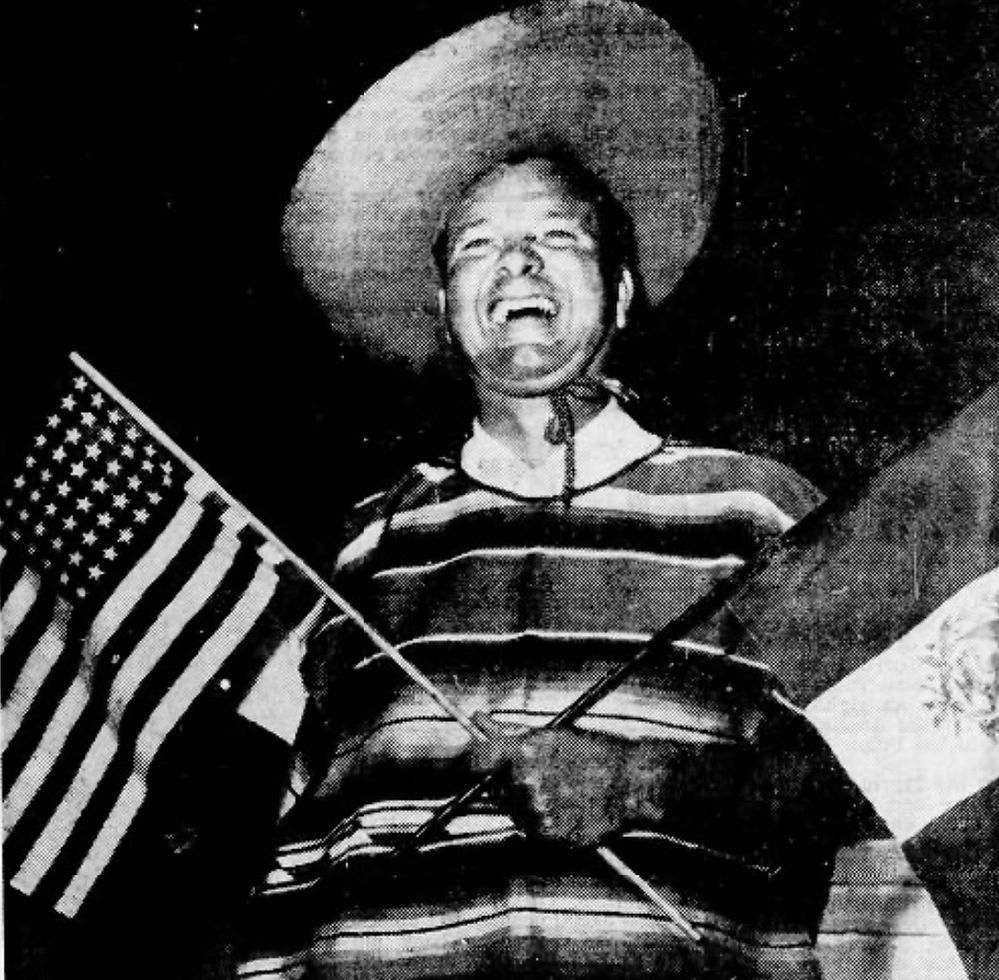
Always one to make a statement, Demaret arrived at Memorial Park on Thursday morning decked out in a Mexican sombrero, brightly colored serape, green slacks, and matching green and brown golf shoes, waving the flags of the United States and Mexico with the song "South of the Border" playing in the background. After posing for photographers, he presented a check to Howard Capps for $1,100, which covered Demaret's fine, along with those of Williams, Snow, and Dudas. The money had been provided by Glenn McCarthy, a wealthy Houston oil baron and long-time friend of Demaret, who had agreed to pay the fines in the interest of good neighborliness. "Demaret says he's right," said McCarthy, "and I'll back him all the way."
Courtesy of a solid second round 68, Demaret was the only one of the Rebel Foursome to make the 36-hole cut that week in Houston. Coincidentally, he was paired in the third round with Horton Smith, and remarkably, the two made it through the day without coming to blows. Demaret's third round 76, coupled with a 71 on the final 18, left him well out of the money, as Marty Furgol claimed the victory and the $2,000 winner's prize. When Vic Ghezzi was barred from the Miami Beach Open two weeks later, Demaret threatened to boycott future PGA events until the issue was resolved. Ghezzi appealed and had his fine reduced to $200, which he repaid, allowing him to rejoin the circuit in time for the Jacksonville Open on March 17. Demaret would not post a single win on the PGA circuit during the 1951 season, reserving his best performances for international play. He won the Havana Open later that fall and went on to achieve a perfect 2-0 record at the Ryder Cup, spurring the U.S. team to a 9 1/2 to 2 1/2 win at Pinehurst in November.
In the end, the response of the golfing community came down largely in favor of Demaret and the other pros who had been fined. On June 2, Demaret was given a special citation by the U.S. State Department for his outstanding contribution to the Good Neighbor Policy of the United States. Three days later, he was the guest of honor at a testimonial dinner sponsored by journalists Grantland Rice and Red Smith, former U.S. Open champion Craig Wood, New York Yankees president Dan Topping, and former PGA tournament director Fred Corcoran. There, he was presented an Award of Merit from President Harry S. Truman and Attorney General J. Howard McGrath for his role in aiding international relations.
Despite receiving the PGA's support in upholding the players' fines, Howard Capps tendered his resignation as tournament supervisor and was replaced by Frank Caywood in December. Meanwhile, the Rio Grande Valley Open, having struggled to attract top-notch players to its tournament, was dropped from the PGA's 1952 schedule. In a move aimed at fostering better relations between the United States and Mexico, the PGA granted permission for 16 professional golfers, including Demaret, Ghezzi, Al Besselink, and Toney Penna, to participate in the 1952 Mexican Open the following February. This decision reflected a strategic effort to enhance cross-border connections through the sport of golf.
Meanwhile, the Rio Grande Valley Open faced challenges in attracting top-tier players, which resulted in the tournament being removed from the PGA's 1952 schedule. In a move aimed at fostering better relations between the United States and Mexico, the PGA granted permission for 16 professional golfers, including notable names such as Demaret, Ghezzi, Al Besselink, and Toney Penna, to participate in the 1952 Mexican Open the following February, a decision that reflected a strategic effort to enhance cross-border connections through the sport of golf.
If much of this sounds familiar, that's because 75 years later, we still encounter these same issues in professional golf. The sport has always attracted individualists—players who relish the freedom to choose which tournaments to enter and when to compete. As John Campaniotte noted in Demaret's 2004 biography, the issue of controlling when and where tour professionals compete has long been a divisive one. In fact, it was among the points of contention that led to the separation of the PGA Tour from the PGA of America in the late 1960s.
As the game moves forward and continues to evolve, it is often enlightening to take a look back at its history. As Theodore Roosevelt once wisely said, "The more you know about the past, the better prepared you are for the future." Unfortunately, reality often aligns better with the observation of Aldous Huxley, when he said, "That men do not learn very much from the lessons of history is the most important of all the lessons of history." In navigating the complexities of modern professional golf, perhaps the greatest challenge remains not just in recalling the past, but in applying its lessons to shape a more harmonious future for the sport.
Spectators attend tournaments not merely for the prestige of the PGA Tour or the influence of corporate sponsors, but for the sheer thrill of watching skilled golfers in action. The excitement of the game, the shot-making skills, and the tension of the competition draw fans in by creating an electric atmosphere that transcends branding. With the PGA Tour striving to enhance its product and boost television ratings, and with several of LIV Golf's standout players potentially looking to rejoin the fold, the Tour and its players must recognize the importance of their symbiotic relationship. This is not just about competition; it's about nurturing the sport itself.
The question looms: will the Tour embrace a spirit of flexibility and cooperation, or will pride and ego cloud their judgment? As they wrestle with the complexities of control and the mission to grow the game, it is crucial for both the Tour and its players to prioritize the sport's legacy. Let's hope that all parties involved can find common ground. By focusing on collaboration and understanding, they have the opportunity to not only preserve the rich history of the game but also to elevate it to new heights. The stakes are high, and golf's immediate future may depend on their ability to navigate this delicate landscape successfully.


Comments