


I'm Dreaming of a White Crosby? Snowy weather at the 1962 Bing Crosby Pro-Am

Updated: Mar 2
Two weekends ago, eastern South Carolina was blanketed with an unusual five inches of snow, prompting dozens of local children to break out everything from sleds to plastic storage lids to cardboard boxes and head to the hill on Florence Country Club's 18th hole for a day of high-speed winter fun. As I viewed the photos of the children and their parents sledding on the golf course and later that afternoon, read about the LPGA's debacle down in Florida, my curiosity got the better of me and I began to research whether a PGA Tour event had ever been delayed by snow.
The first snow delay of a PGA tournament occurred at the 1940 Greater Greensboro Open, when a freak Easter Day snow storm covered Starmount Country Club with five inches of snow on March 25, 1940, causing the postponement of the final 36 holes by two days and delaying the start of the Land of the Sky Open the following weekend in Asheville. The second would come nearly 22 years later at the 1962 Bing Crosby Pro-Am, and while bad weather was never a big surprise for players at the Crosby, nothing could have prepared them for the chaos that would reign in Carmel-by-the-Sea that weekend.
The week started off with business as usual except for the notable absence of Bing Crosby, who was missing his tournament for the first time ever while recovering from kidney surgery two weeks prior. Defending champion Bob Rosburg enjoyed mild temperatures as he played his practice rounds at Cypress Point and Monterey Peninsula, and tournament officials were hopeful for a record turnout of 50,000 to 60,000 spectators that week. The star-studded field of 324 professional and amateur golfers assembled for Crosby's annual clambake included the winners of all four of the previous year's major championships. Gary Player, who won his second major at the 1961 Masters, was listed as a 6-1 favorite this week, followed closely by Arnold Palmer, who won the '61 Open Championship at Birkdale, at 8-1. Gene Littler, winner of his one-and-only U.S. Open championship at Oakland Hills, was considered talented but unpredictable and was given longer odds at 20-1, while PGA Champion Jerry Barber was not expected to be among the contenders this week. The start of the 1962 season had seen several young guns rise to the top. Twenty-three year-old Phil Rodgers won the L.A. Open, 26-year-old Tommy Jacobs took the San Diego Open. and young Jack Nicklaus, who won the 1961 U.S. Amateur at Pebble Beach, was considered the favorite to win this year's Crosby. However, as 1959 Crosby winner Art Wall wisely pointed out, "so much depends on the weather."
Meteorologists predicted fair weather for all four days of the $50,000 tournament. In fact, the U.S. Naval Facilities' meteorologist saw no pattern out at sea that could produce rain through the weekend. "That pattern could change," he said, "but right now there is nothing in sight for 5,000 miles. Conditions were ripe for scoring during Thursday's first round, and the trio of Phil Rodgers, Joe Campbell, and Chuck Congdon shared the lead at 67. A former NCAA champion out of Purdue, Campbell fought off the aches of a flu virus to birdie five of the final seven holes at Monterey Peninsula to card his 67, while Rodgers finished strong with four back-nine birdies, and Congdon, winner of the 1948 Canadian Open, holed birdie putts of 20 and 40 feet to claim his share of the lead.
The story of the day, however, was the 16th hole at Cypress Point, which had already claimed three victims so far that week. It started before the tournament began, when British pro Guy Wolstenholme was walking across the bridge near the tee box during his practice round, slipped and fell, and broke his elbow. Long regarded as one of the most iconic holes in all of golf, the 16th requires a 200-plus yard carry over the ocean to a large green that sits on a rocky out-cropping and is guarded by a rugged cliff and six menacing bunkers. After finishing the first fifteen holes at level-par, Jerry Barber landed his first tee shot in the water, took a penalty stroke, and hit his third across the fairway into the rocks. He failed to get that shot out and landed among the ice plants, and he struggled mightily from there, his ball finally finding the green after his eighth stroke. Even par heading into 16, the defending PGA champion two-putted for a 10 and ended his round with a 7-over 79, effectively taking him out of contention.
The 16th was also unkind to spectators on Thursday. Play was delayed briefly when Lawrence Lucchesi, a San Francisco bartender, was rushing to watch Tommy Bolt play a shot off the beach, lost his footing, and plunged twenty feet down the cliff to the left of the green. Thankfully, his fall was broken by the ice plants and ambulances took him to the hospital where he had surgery for a broken shoulder. On a humorous note, it was reported later that when Lucchesi emerged holding his injured arm, someone in the crowd saw him and yelled down, "What do you lie?"
It was a rough week for golf fans that weekend. A female spectator was hit on the shin when country singer Tennessee Ernie Ford skulled a chip shot over the green on the 12th at Cypress Point. Fortunately for Ford, who was paired with Gary Player, the ball ricocheted back leaving him with a 9-footer for par. On Friday, ambulances were called simultaneously to the same hole, one for a lady who was hit by an errant tee shot and another for a man having a heart attack. Finally, on Thursday night, Charlene Cassini, wife of New York columnist Igor Cassini, had $44,000 worth of jewelry stolen from her suite at the Del Monte Lodge while she and her husband were out to dinner at the home of Taylor Pillsbury. While local authorities and the FBI investigated the theft the next day, Cassini joined his pro-am partner, Eddie Merrins, for a rainy, wind-swept round at Cypress Point.
Gale warnings went up along with Northern California coast as winds gusting up to 40 knots buffeted the peninsula and over an inch of rain fell Friday over the tournament's three courses as only 12 players broke par--two at Pebble Beach, one at Cypress Point, and nine at Monterey Peninsula. Fighting the elements as much as the flu, Joe Campbell survived Friday's round with a 71 and held a three-stroke lead over Ken Venturi and 1961 Rookie-of-the-Year Jacky Cupit at the tournament's midway point. Winds Friday afternoon and evening blew over tents and trees, knocking out power to the press room and sending many news reporters scrambling to find candles in order to meet their deadlines. At some point during the night, another thief broke into the hotel room of Tarzan actor Johnny Weismuller and stole his wallet and golf clubs, prompting him to withdraw from the tournament Saturday morning.
Despite improved scoring conditions Saturday, Cupit went backwards with a 78 at Cypress Point to finish at 217. Dave Hill was so disgusted after bogeying the 18th at Pebble Beach that afternoon to shoot 79 and miss the 54-hole cut that he told his caddie to "throw his (expeletive) putter in the ocean." A crowd of around 25,000 looked on as Doug Ford got back to within two of Campbell, firing a 3-under-par 69. When all the scores were posted that afternoon, Campbell still held the lead after a third round 72, which left him at 210, while Ford followed next at 212. Venturi and Phil Rodgers were another two strokes back at 214, and Tony Lema headed a group of six golfers at 216.
When they went to bed Saturday night, everyone in central California expected a routine final round at Pebble Beach on Sunday. The headline of a special Sunday edition of the Monterey Peninsula Herald read: "Sunday Golf Forecast Dry Skies." The next morning, however, they awoke to something that had not happened at Pebble Beach in the past 38 years. Overnight, a storm moving eastward through the Pacific about 200 miles west of the California-Oregon border intensified, and the northerly winds powering the disturbance blew in a mass of Arctic air from southwestern Canada. The storm moved inland Sunday morning just before the start of the final round, bringing a mixture of hail and snow to Pebble Beach just as the first group was teeing off that morning.
Arnold Palmer woke up that morning with a sore throat. "I sure don't feel like playing," he told someone earlier. "I wish it would snow, or something, so they'd call it off." He got his wish. Traffic was snarled on Highway 101 as cars of spectators sloshed and slid off the road, and high winds and frozen conditions caused more power outages in the area. Canadian pro Wilf Homeniuk, who made the cut on the number, was flabbergasted, "I came down here to get out of the cold, but I think it's colder here this morning than it is back home in Winnipeg." It was reported that one fan looked at the snow outside his motel window and said, "What am I doing in Squaw Valley?"
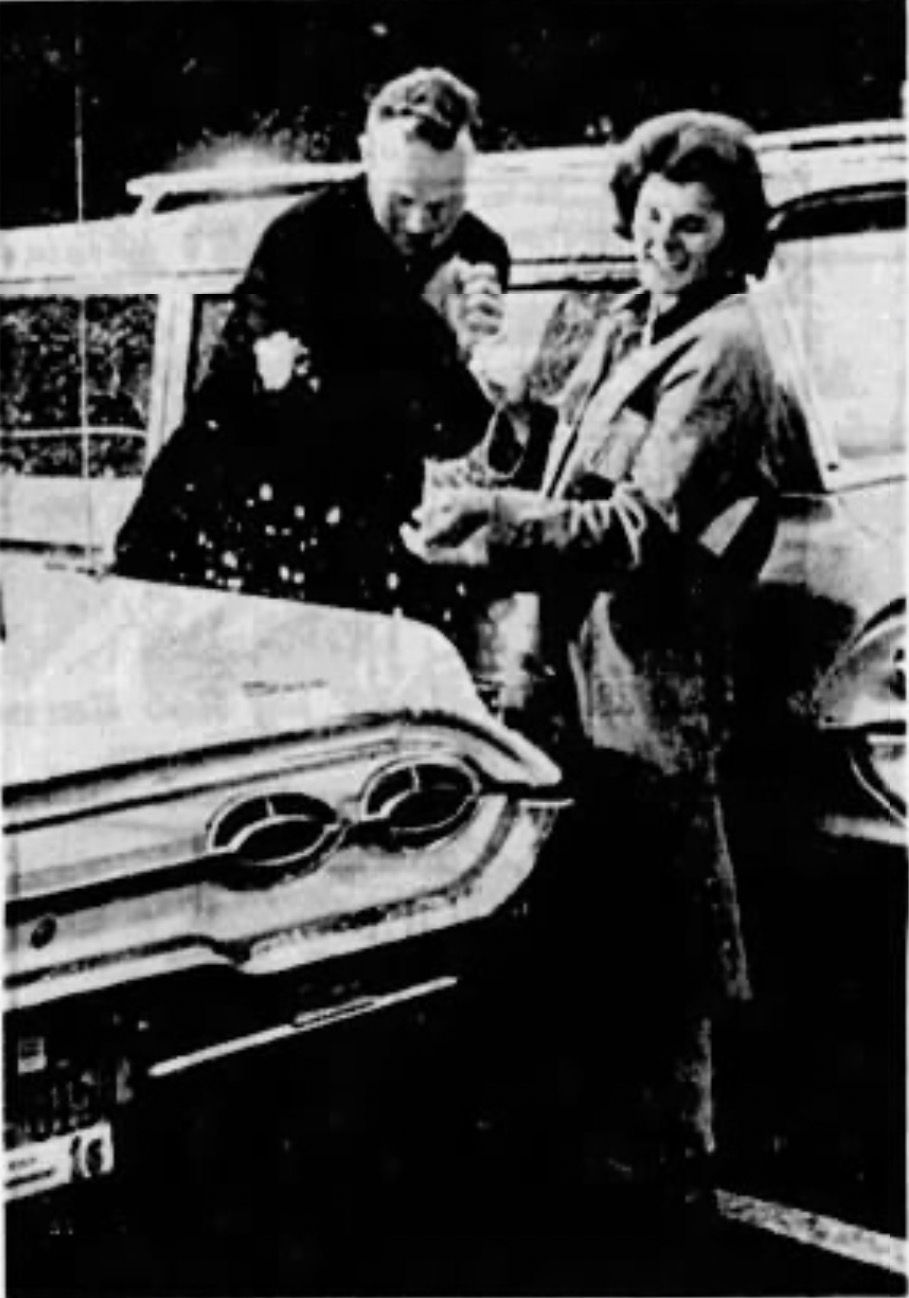
Arnold and Winnie Palmer enjoy a snowball fight in the parking lot at Pebble Beach (AP Photo)
Conditions continued to deteriorate, and by the time Gardner Dickinson, playing in the fourth group of the day with Billy Casper, reached his ball on the first fairway, it was covered with frozen precipitation. During a break in the storm, crews began to sweep the greens clear of snow and hail, but as soon as they finished, it began snowing again. With two inches of snow on the ground, tournament officials realized that further efforts to make the course playable would prevent everyone from finishing their round and decided to postpone the final round until Monday.
Tournament director Larry Crosby was not happy about the postponement, but there was nothing he could do. Many fans, and some of the participants, had to return home to their jobs and began checking out of hotels in droves. The anticipated 50,000 to 60,000 gate would now be unattainable, and it certainly didn't help matters that the IRS was investigating the tournament over their failure to file for non-profit status. But as they say, the show must go on. There was still frost on the course when play began and many sand traps were so frozen that many bunker shots required the deft use of a putter. Unfortunately for Campbell, his putting stroke left him on Monday and he had only one one-putt green all day, when he chipped it to within three inches and tapped in for par at the 6th. Campbell shot a 4-over 76 in the final round as Doug Ford, whom Campbell called "a Houdini playing in bad weather," shot a 74 to tie him. Campbell then proceeded to three-putt from 60 feet on the first hole of sudden death, while Ford blasted to within 6 feet from a green-side bunker and sank the putt for the win.
Ford's putt climaxed what sportswriter Norm Hannon called "one of the most jinxed Crosbys ever played." Despite taking a big hit at the gate, the tournament still managed to give $100,000 to charity, courtesy of a sweet $75,000 television contract. Far from being discouraged by the weather and the complaints of some participants about course over-crowding and favoritism toward some amateurs, Larry Crosby remained upbeat about the event. "It's a headache, but as far as I know, Bing will always be behind this tournament." His goal was to expand to four courses and keep the field at 324, but for the most part, the format would remain the same. Given the tradition of the clambake, Crosby said he expected there would "always be a Bing Crosby Tournament."
Bing Crosby hosted his annual clambake for 25 more years until his death in 1977, and his family hosted the tournament for eight more years in his honor until 1985, when Mark O'Meara beat Curtis Strange by a stroke to capture the final Bing Crosby National Pro-Am. In 1986, the tournament was re-branded and renamed the AT&T Pebble Beach National Pro-Am, and continues under that name today. Though the tournament no longer bears the Crosby name, one thing that has not changed is the ever-present threat of "Crosby Weather." This year, third-round leader Akshay Bhatia battled 35 mile-per-hour winds to forge a tenuous two-stroke cushion over Collin Morikawa, Jake Knapp, and Sepp Straka. Although it won't snow, the conditions today are expected to be difficult again, and will surely make for an exciting finish.
Today, the purse of the tournament Crosby started has grown from $50,000 in 1962 to $20 million. It is now played over two courses, Spyglass Hill and Pebble Beach with a field that is limited to 80 pros and 80 amateurs, and is the first signature event of the PGA season. The AT&T pro-am has evolved over time, but has remained true to its foundational principles. The format, pairing professionals with celebrities and business leaders, provides a unique blend of competition and entertainment and its enduring appeal is a testament to its ability to adapt and resonate with a wide audience over time. As the tournament continues to evolve, one thing remains clear: the legacy of Bing Crosby is inextricably linked to its rich history. With each passing year, the AT&T Pro-Am not only honors its past but also paves the way for a bright future, ensuring that the spirit of competition and camaraderie will thrive for generations to come.

Local children and their parents enjoy sledding down the 18th hole at Florence Country Club during the recent South Carolina snow event.


Awesome article!